Ownership and Management

This page discloses in full who owns Syntax: Journal of Software Engineering, Computer Science and Information Technology, who publishes and manages it, how it is financed, and how editorial independence is protected. It is published so that authors, readers, reviewers, indexing services, and accreditation bodies can verify the governance of the journal without having to ask.

1. Journal Identity

FULL TITLE

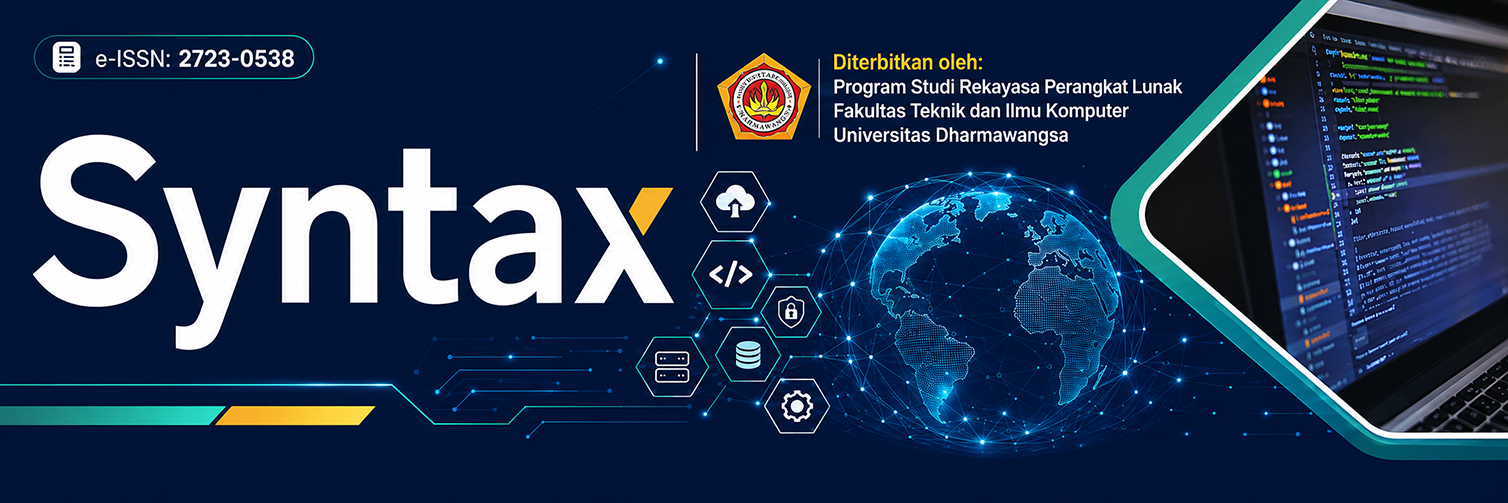
Syntax: Journal of Software Engineering, Computer Science and Information Technology

ABBREVIATED TITLE

Jurnal Syntax

ELECTRONIC ISSN

2723-0538 (online, open access — the journal does not publish a print edition)

DOI PREFIX

10.46576 — every article receives a registered Crossref DOI in the form https://doi.org/10.46576/syntax.vXiY.NNNN

FIRST PUBLISHED

Volume 1, 2020. The journal has published continuously since that date.

PUBLICATION FREQUENCY

Two issues per year, in June and December.

LANGUAGES

Indonesian and English. Every article carries an English title, abstract, and keywords.

NATIONAL ACCREDITATION

Accredited by the Ministry responsible for higher education, science and technology of the Republic of Indonesia, and listed in SINTA.

PUBLISHING PLATFORM

Open Journal Systems (OJS) 3.5 by the Public Knowledge Project, self-hosted on the servers of Universitas Dharmawangsa at jurnal.dharmawangsa.ac.id.

2. Ownership

Legal Owner

Universitas Dharmawangsa, a private higher-education institution established under Indonesian law and located in Medan, North Sumatra. The university holds the title, the ISSN registration, the DOI prefix, and the domain on which the journal is hosted.

No Society or Third-Party Ownership

The journal is not owned, co-owned, sponsored, or financially controlled by any learned society, association, commercial publisher, foundation, political organisation, or individual. There is no co-publishing agreement and no revenue-sharing arrangement with any external party.

Intellectual Property

The journal does not acquire copyright in the articles it publishes. Authors retain copyright, and articles are distributed under CC BY-NC-SA 4.0. The university's ownership extends to the journal title, trademark, and platform, not to the scholarly content.

Not for Profit

The journal is operated on a not-for-profit basis as part of the academic service mission of the university. Any surplus from Article Processing Charges is applied to the operating costs of the journal and is not distributed as profit.

3. Publisher and Managing Unit

Publisher: Software Engineering Study Program (Program Studi Rekayasa Perangkat Lunak), Faculty of Engineering and Computer Science, Universitas Dharmawangsa.

Registered address: Jl. K.L. Yos Sudarso No. 224, Medan 20115, North Sumatra, Indonesia.

Journal website: https://jurnal.dharmawangsa.ac.id/index.php/syntax
Editorial e-mail: admin_syntax@dharmawangsa.ac.id

The Software Engineering Study Program carries operational and financial responsibility for the journal: it appoints the editorial team, approves the annual budget, maintains the OJS installation together with the university's information technology unit, administers the Crossref membership, and submits the journal for national accreditation and for inclusion in indexing services.

4. Management Structure

1

Editor in Chief

Dr. Zulham, S.Kom., M.Kom. — Universitas Dharmawangsa, Medan, Indonesia.

Authority: holds final responsibility for the editorial content of the journal, for the appointment and recusal of handling editors, for decisions on corrections, expressions of concern, and retractions, and for the integrity of the peer review process. Reports to the Head of the Software Engineering Study Program on administrative matters only, never on decisions concerning individual manuscripts.

2

Editorial Board

Composition: eleven editors drawn from Universitas Dharmawangsa and from eight other institutions, including Universitas Islam Negeri Sumatera Utara, Universitas Pembangunan Panca Budi, Politeknik Pertanian Negeri Payakumbuh, Institut Pendidikan Tapanuli Selatan, Universitas Islam Kebangsaan Indonesia, and STMIK Logika. The majority of the board is based outside the publishing institution.

Function: screening submissions for scope and originality, selecting reviewers, assessing reviewer reports, recommending decisions, and advising on policy. The full list with affiliations is published at Editorial Team.

3

Reviewer Panel

External peer reviewers are appointed on the basis of documented expertise and publication record. Reviewers are listed publicly at Reviewer, and no reviewer assesses a manuscript from their own institution.

4

Technical and Production Support

Dr. Ananda Hadi Elyas, M.Kom. — Universitas Dharmawangsa. Responsible for the OJS platform, metadata deposit, DOI registration, galley production, and preservation of the published files. Technical staff have no role in editorial decisions.

5

Appointment and Term

Appointment: editors are appointed by decree of the Dean of the Faculty of Engineering and Computer Science on the recommendation of the Editor in Chief and the Head of the Study Program, for a renewable term of three years.

Review of the board: membership is reviewed annually against activity and conflict-of-interest declarations. Inactive members are replaced, and the published list is updated accordingly.

5. Sources of Revenue

  • Institutional support. The principal source of funding is the annual operating budget of the Software Engineering Study Program and the Faculty of Engineering and Computer Science, which covers hosting, the Crossref membership, similarity-check licensing, and staff time.
  • Article Processing Charges. Authors pay no submission fee. A publication fee of IDR 400,000 (regular) or IDR 550,000 (fast-track) is charged only after a manuscript has been accepted. The full schedule is published at Article Processing Charge.
  • No reader-side revenue. The journal earns nothing from readers: there are no subscriptions, no pay-per-view charges, no membership fees, and no paywalls of any kind.
  • No commercial sponsorship. The journal accepts no sponsorship, grant, or donation that is conditional on editorial treatment of any subject, author, institution, or product.

6. Advertising and Direct Marketing

Advertising Policy

Jurnal Syntax does not accept advertising of any kind on its website, in its issues, or in its correspondence. No commercial content appears on article pages, and no third-party advertising network is embedded in the platform. Logos displayed on the site identify indexing services, accreditation bodies, and tools used by the journal; they are not paid placements.

Direct Marketing Policy

Calls for papers are distributed only through the journal website, its announcements page, the registered mailing list of the journal, and the official channels of Universitas Dharmawangsa. The journal does not send unsolicited bulk invitations, does not purchase or rent e-mail lists, and does not engage agents or brokers to solicit manuscripts. Any message offering guaranteed or accelerated acceptance in exchange for payment is fraudulent and should be reported to the editorial office.

7. Editorial Independence

Decisions rest with the editors aloneAcceptance or rejection is determined solely by the scientific quality, originality, methodological soundness, and relevance of a manuscript, as established through double-blind peer review. Neither the owner, nor the publisher, nor the faculty leadership, nor any funder or external party may direct, overturn, or delay a decision on an individual manuscript. Payment of the Article Processing Charge has no bearing on the outcome of review.

Where a member of the editorial team, or a person holding office in the owning institution, is an author of a submission, the manuscript is reassigned to an independent handling editor at another institution and the person concerned is excluded from the editorial record. The procedure is set out in the Conflict of Interest policy.

8. Indexing, Preservation, and Continuity

  • Indexing and abstracting. SINTA, Garuda, Google Scholar, Crossref, Dimensions, BASE, Index Copernicus, ROAD, and Indonesia OneSearch. The current list is maintained at Indexing.
  • Persistent identification. Every article, and every correction or retraction notice, is registered with Crossref and carries a DOI that resolves permanently, independent of any change to the journal's web address.
  • Metadata harvesting. Full metadata is exposed through OAI-PMH, allowing national and international aggregators to harvest and preserve the bibliographic record.
  • Digital preservation. Published files and the OJS database are backed up on university infrastructure, and the full text of every article is additionally deposited in the institutional repository of Universitas Dharmawangsa.
  • Continuity undertaking. Should the journal cease publication, change title, or transfer to another publisher, the owner undertakes to keep all previously published content freely accessible at its registered DOIs and to announce the change on this page and in the journal's announcements.

9. Complaints About the Management of the Journal

Complaints concerning the conduct of the editorial office, the handling of a submission, delays in review, or the application of this policy should be sent in writing to the Editor in Chief at admin_syntax@dharmawangsa.ac.id. Receipt is acknowledged within five working days and a substantive reply is given within thirty days. A complainant who is not satisfied with the outcome, or whose complaint concerns the Editor in Chief personally, may escalate it to the Head of the Software Engineering Study Program and, if necessary, to the Dean of the Faculty of Engineering and Computer Science at the registered address above.

Editorial Office — Jurnal Syntax
Software Engineering Study Program, Faculty of Engineering and Computer Science
Universitas Dharmawangsa
Jl. K.L. Yos Sudarso No. 224, Medan 20115, North Sumatra, Indonesia
E-mail: admin_syntax@dharmawangsa.ac.id
Full contact details and helpdesk numbers: Contact

This disclosure is reviewed and, where necessary, updated at the start of each volume. Last reviewed: October 2026.

This disclosure is prepared in accordance with the Principles of Transparency and Best Practice in Scholarly Publishing issued jointly by COPE, DOAJ, OASPA, and WAME. See publicationethics.org