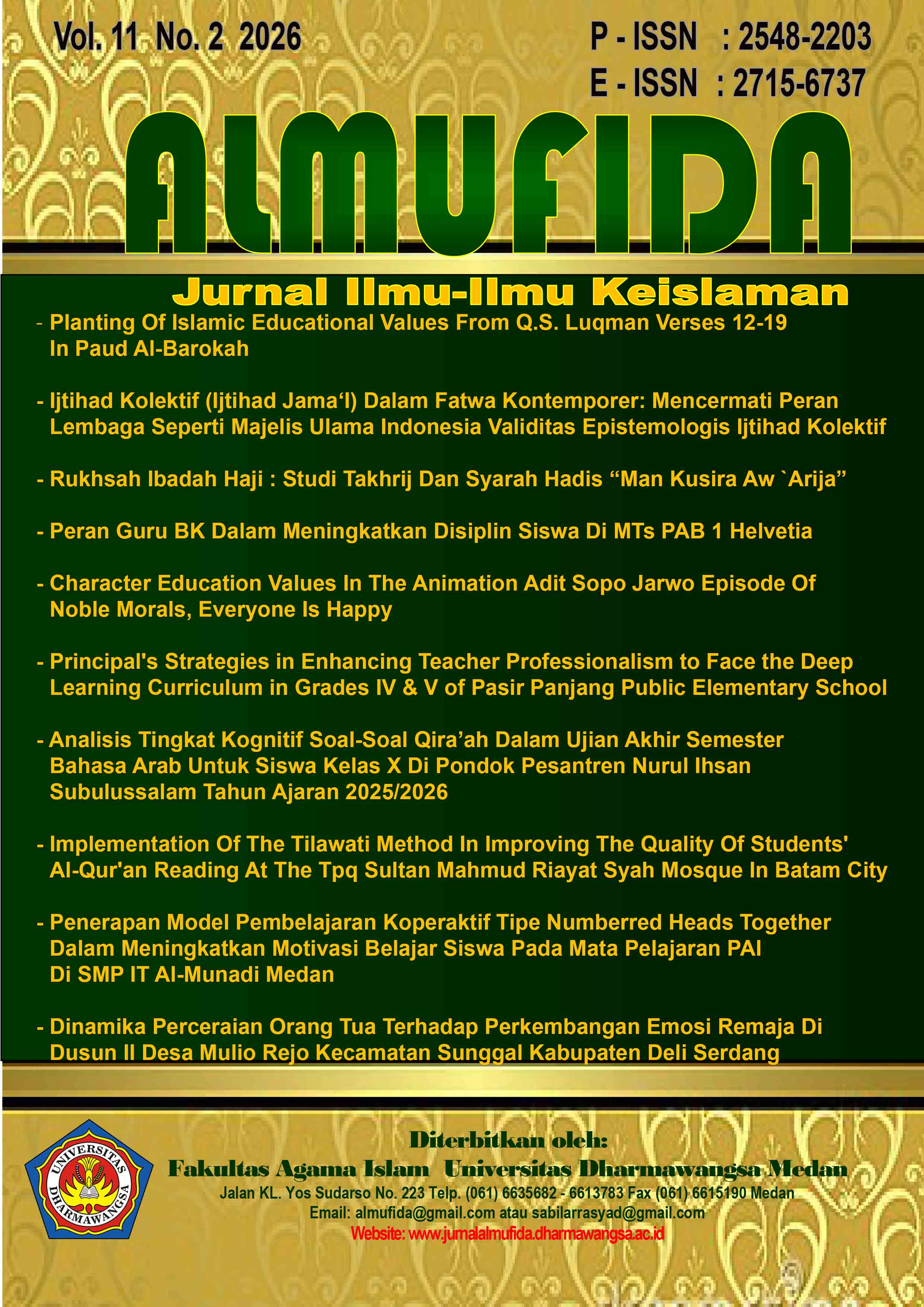
IJTIHAD KOLEKTIF (IJTIHAD JAMA‘I) DALAM FATWA KONTEMPORER: MENCERMATI PERAN LEMBAGA SEPERTI MAJELIS ULAMA INDONESIA VALIDITAS EPISTEMOLOGIS IJTIHAD KOLEKTIF
DOI:
https://doi.org/10.46576/almufida.v11i2.9690Keywords:
Collective Ijtihad, Bayani-Burhani Epistemology, Indonesian Ulema Council (MUI), Contemporary Fatwa, Positivization of Law.Abstract
The dynamics of contemporary modernity have generated highly complex, transdisciplinary legal dilemmas encompassing technology, bioethics, and the digital Islamic economy. This boundless expansion of social realities (ghairu mutanāhiyah) stands in stark contrast to the finite nature of foundational religious texts (mutanāhiyah). Such complexity induces a functional paralysis in individual ijtihad (ijtihad fardī), as contemporary issues can no longer be accurately resolved solely through the mastery of classical uṣūl al-fiqh principles and pure Arabic philology.
Consequently, collective ijtihad (ijtihad jamā‘ī) has emerged as a methodological necessity (ḍarūrah manhajiyyah).
This study aims to dissect the nature and epistemological structure of collective ijtihad, as well as the validity of its legal outcomes in addressing contemporary issues objectively and accurately within the maqāṣid asy-syarī‘ah framework. Theoretically, collective ijtihad occupies a unique position: below the threshold of classical absolute consensus (ijmā‘ mutlaq)—which demands an almost utopian unanimity—yet far superior to individual ijtihad, as it yields a higher degree of verified probabilistic certainty (ẓan al-mu‘tabar) and carries institutional recognition (al-ijmā‘ al-mu’assasī).
This manifestation of collective ijtihad is analyzed through the lens of the Fatwa Commission of the Indonesian Ulema Council (Majelis Ulama Indonesia / MUI). MUI exemplifies sociological inclusivity by weaving together representation from various Islamic mass organizations while synergizing multidisciplinary experts across medical/bioethical, food/biotechnology, and financial-economic clusters.
The findings reveal an extraordinary socio-legal anomaly within the Indonesian legal landscape. Although a fatwa theoretically possesses only moral-religious binding force (ilzām ad-diyānī), the products of MUI's collective ijtihad have successfully transformed into formally binding positive law (ilzām al-qaḍā’ī) through legislative channels (such as the Islamic Banking Act and the Halal Product Assurance Act) as well as state administrative regulations. While this integration draws constitutional criticism regarding the public accountability of a non-governmental institution, epistemologically, this phenomenon represents the pinnacle of collective ijtihad's efficacy in rendering Islamic law functional and applicable within a modern state.
References
Abdullah, Amin, Islamic Studies di Perguruan Tinggi: Pendekatan Integratif-Interkonaktif
(Yogyakarta: Pustaka Pelajar, 2006).
al-Amidi, Saif al-Din, Al-Iḥkam fi Uṣul al-Aḥkam, Juz IV (Riyadh: Dar al-Sumay'i, 2003). Al-Ghazali, Abu Ḥamid, Al-Mustaṣfa min ‘Ilm al-Uṣul, Juz I (Beirut: Dar al-Kutub al-
Ilmiyyah, 1993),.
Ali, Mohammad Daud, Hukum Islam: Pengantar Ilmu Hukum dan Tata Hukum Islam di Indonesia (Jakarta: Rajawali Pers, 2012).
Al-Jabiri, Muhammad Abed, Bunyah al-‘Aql al-‘Arabi: Dirasah Naqdiyyah Tahliliyyah li Nuẓum al-Ma‘rifah fi al-Tsaqafah al-‘Arabiyyah (Beirut: al-Markaz al-Tsaqafi al-Arabi, 1991.
Al-Qarafi, Shihab al-Din, Al-Inwar fi Anwa‘ al-Furuq, Juz II (Kairo: Dar al-Salam, 2001). Al-Qardhawi, Yusuf, Al-Ijtihad al-Mu‘aṣir baina al-Inḍibaṭ wa al-Infitaḥ (Kairo: Dar al-
Shuruq, 2011).
, Al-Ijtihad fi asy-Syari‘ah al-Islamiyyah ma‘a Naẓarat fi al-Ijtihad al-Mu‘aṣir (Kuwait: Dar al-Qalam, 1996).
Al-Syaṭibi, Abu Isḥaq, Al-Muwafaqat fi Uṣul asy-Syari‘ah, Juz II (Kairo: Al-Maktabah al-Tijariyyah al-Kubra, t.th.).
Al-Zuhayli, Wahbah, Uṣul al-Fiqh al-Islami, Juz II (Damaskus: Dar al-Fikr, 1986).
Al-Zutari, Abdul Majid, Al-Ijtihad al-Jama‘i wa Dawruhu fi Tasyri‘ al-Ahkam al-Mu‘aṣirah (Amman: Dar al-Nafais, 2018).
Amin, Ma'ruf, Fatwa dalam Sistem Hukum Islam (Jakarta: El-Sas, 2008).
Asshiddiqie, Jimly, Dinamika Hukum dan Keadilan (Jakarta: Intrans Publishing, 2015). Azra, Azyumardi, Islam dalam Batas Belenggu: Ortodoksi, Heterodoksi, dan
Reaktualisasi di Indonesia (Jakarta: Paramadina, 2004).
Bik, Muhammad al-Khudari, Tarikh at-Tasyri‘ al-Islami (Kairo: Dar al-Fikr, 1967). Hallaq, Wael B., A History of Islamic Legal Theories: An Introduction to Sunni Uṣul al-
Fiqh (Cambridge: Cambridge University Press, 1997).
Ibn Manẓur, Lisan al-‘Arab, Juz III (Kairo: Dar al-Ma'arif, t.th.).
Kamali, Mohammad Hashim, Principles of Islamic Jurisprudence (Cambridge: Islamic Texts Society, 2003).
Khallaf, Abd al-Wahhab, ‘Ilm Uṣul al-Fiqh (Kairo: Maktabah ad-Da'wah al-Islamiyyah, 1968).
Majelis Ulama Indonesia, Himpunan Fatwa MUI Sejak 1975 (Jakarta: Erlangga, 2011). Mubarok, Jaih, Metodologi Ijtihad Hukum Islam (Yogyakarta: Pustaka Pelajar, 2002). Mubarok, Jaih, Perkembangan Fatwa Ekonomi Syariah di Indonesia (Bandung: Remaja
Rosdakarya, 2017).
Mudzhar, M. Atho, Fatwas of the Council of Indonesian Ulama: A Study of Islamic Legal Thought in Indonesia 1975-1988 (Jakarta: INIS, 1993).
Raisuni, Ahmad, Naẓariyyat al-Maqaṣid ‘inda al-Imam al-Syaṭibi (Riyadh: Dar al-Alamiyyah al-Kitab al-Islami, 1992).
Sholeh, Asrorun Ni'am, Metodologi Fatwa Majelis Ulama Indonesia: Analisis Teoretis dan Praktis (Jakarta: Erlangga, 2014).
Syamsuddin, Jasyim, Al-Ijtihad al-Jama‘i fi al-Tasyri’ al-Islami (Kairo: Dar al-Kitab al-Jam'i, 2002).
Undang-Undang Republik Indonesia Nomor 21 Tahun 2008 tentang Perbankan Syariah.
Undang-Undang Republik Indonesia Nomor 33 Tahun 2014 tentang Jaminan Produk Halal.
Yanggo, Huzaemah Tahido, Masail Fiqhiyah Kontemporer (Jakarta: PT Bumi Aksara, 2019).
, Pengantar Perbandingan Mazhab (Jakarta: Logis, 2003).
Downloads
Published
Issue
Section
License
Authors who publish with this journal agree to the following terms:- Authors retain copyright and grant the journal right of first publication with the work simultaneously licensed under a Creative Commons Attribution License 4.0 that allows others to share the work with an acknowledgement of the work's authorship and initial publication in this journal.
- Authors are able to enter into separate, additional contractual arrangements for the non-exclusive distribution of the journal's published version of the work (e.g., post it to an institutional repository or publish it in a book), with an acknowledgement of its initial publication in this journal.
- Authors are permitted and encouraged to post their work online (e.g., in institutional repositories or on their website) prior to and during the submission process, as it can lead to productive exchanges, as well as earlier and greater citation of published work (See The Effect of Open Access).
112.jpg)