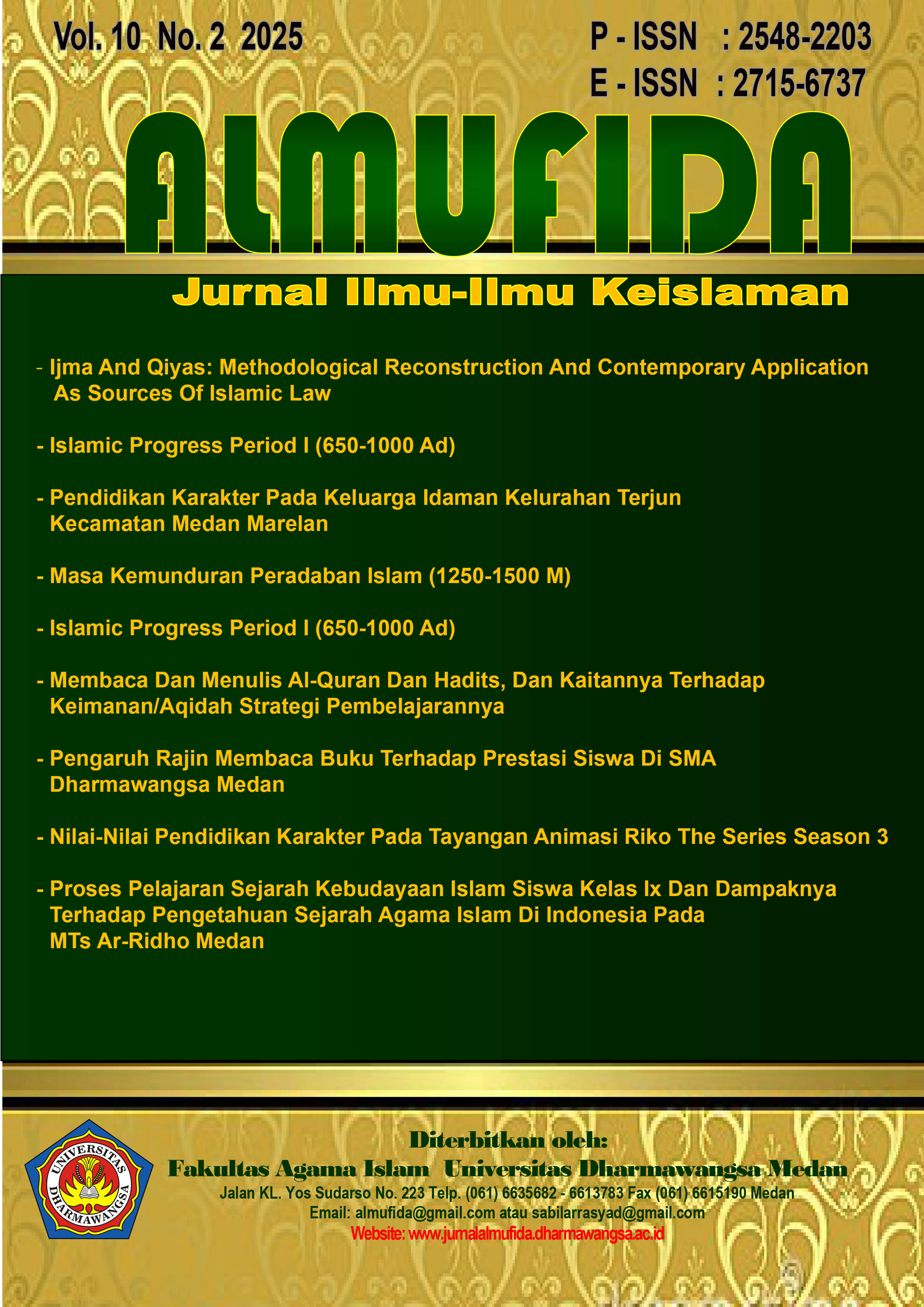
IJMA AND QIYAS: METHODOLOGICAL RECONSTRUCTION AND CONTEMPORARY APPLICATION AS SOURCES OF ISLAMIC LAW
DOI:
https://doi.org/10.46576/almufida.v10i2.8257Keywords:
Ijma, Qiyas, Methodological Reconstruction, Contemporary Application, Maqasid al-Shari'ah.Abstract
This paper discusses the crucial role of Ijma’ (scholarly consensus) and Qiyas (analogy) as sources of Islamic law alongside the Qur'an and Sunnah, offering a methodological reconstruction and contemporary application of both. The study aims to revitalize the understanding and utilization of Ijma’ and Qiyas so that they remain relevant in addressing modern legal challenges. jma’ is traditionally understood as the absolute agreement of mujtahid scholars. This paper reconstructs the concept of Ijma by emphasizing Ijma’ Sukuti (silent consensus) and the Majma’ al-Fiqh al-Islami (contemporary Islamic Legal Council consensus), acknowledging the dynamics and diversity of views. This reconstruction allows Ijma’ to become a more flexible tool for legal legitimation that is compatible with the context of the modern nation-state. Qiyas is examined as a method of analogical reasoning that ensures legal consistency. The paper highlights the importance of accurately identifying the 'Illat (ratio legis/legal cause) that is appropriate and relevant to the objectives of Shariah (Maqasid al-Shari'ah). The contemporary application of Qiyas is explored in emerging issues such as modern financial transactions, biotechnology, and cyber law, where explicit stipulations from the Qur'an and Sunnah are unavailable. By reconstructing the methodological framework of these two sources, the paper argues that Ijma’ and Qiyas, when applied contextually and grounded in the Maqasid al-Shari'ah, can serve as powerful instruments of ijtihad (independent legal reasoning) to produce adaptive, progressive, and solution-oriented Islamic fatwas and legislation for the complexities of modern life.References
Ahmad, M. T. (2021). Methodological Challenges of Ijtihad in the Digital Age: Re-examining Qiyas. London: Routledge.
Al-Amidi, S. A. Ḥ. A. M. (2003). Al-Iḥkam fi Uṣul al-Aḥkam. Beirut: Dar al-Ṣami’i.
Al-Atrasy, A. K. (2018). Fiqh Al-Bi’ah: Dirasah Taṭbiqiyyah li Uṣul al-Fiqh. Yordania: Dar al-Masirah,
Al-Bukhari, A. (1997). Kashf al-Asrar ‘an Uṣul al-Fakhar al-Bazdawi. Beirut: Dar al-Kutub al-‘Ilmiyyah.
Al-Dirini, F. (2017). Al-Manhaj al-Uṣuli fi Fiqh al-Bi’ah. Beirut: Dar Ibn Katsir.
Al-Ghazali, A. H. M. M. (1993). Al-Mustaṣfa min ‘Ilm al-Uṣul. Beirut: Dar al-Kutub al-‘Ilmiyyah.
Al-Khin, M. S. (1969). Atsar al-Ikhtilaf fi al-Qawa’id al-Ushuliyyah fi Ikhtilaf al-Fuqaha. Kairo: Muassasah al-Risalah.
Al-Muslih, A. A. M. (2019). Fiqh al-Mu’amalat al-Maliyyah al-Mu’aṣirah, Riyadh: Maktabah al-Rusyd.
Al-Nawawi, T. (2011). Al-Majmu’ Sharḥ al-Muhadhdhab. Jeddah: Maktabah Irsyad.
Al-Qardhawi, Y. (2001).Fiqh al-Nawazil. Kairo: Maktabah Wahbah.
Al-Sarakhsi, M. A. (1993). Uṣul al-Sarakhshi. Beirut: Dar al-Kutub al-‘Ilmiyyah.
Al-Syafi’i, M. I. (1995). Al-Risalah, Damaskus: Dar al-Fikr.
Al-Syaukani, M. A. (2000). Irsyad al-Fuḥul ila Taḥqiq al-Ḥaqq min ‘Ilm al-Uṣul. Riyadh: Dar al-Faḍilah.
Al-Zuhayli, W. (1986). Uṣul al-Fiqh al-Islami. Damaskus: Dar al-Fikr.
Goldziher, I. (1981). Introduction to Islamic Theology and Law. Terj. Andras Hamori dan Ruth Hamori. Princeton: Princeton University Press.
Hallaq, W. B. (1997). A History of Islamic Legal Theories: An Introduction to Sunni Uṣul al-Fiqh. Cambridge: Cambridge University Press.
Zarqa, M. A. (1999). Al-Fiqh al-Islami fi Thawbihi al-Jadid. Damaskus: Dar al-Qalam.
Downloads
Published
Issue
Section
License
Authors who publish with this journal agree to the following terms:- Authors retain copyright and grant the journal right of first publication with the work simultaneously licensed under a Creative Commons Attribution License 4.0 that allows others to share the work with an acknowledgement of the work's authorship and initial publication in this journal.
- Authors are able to enter into separate, additional contractual arrangements for the non-exclusive distribution of the journal's published version of the work (e.g., post it to an institutional repository or publish it in a book), with an acknowledgement of its initial publication in this journal.
- Authors are permitted and encouraged to post their work online (e.g., in institutional repositories or on their website) prior to and during the submission process, as it can lead to productive exchanges, as well as earlier and greater citation of published work (See The Effect of Open Access).
112.jpg)