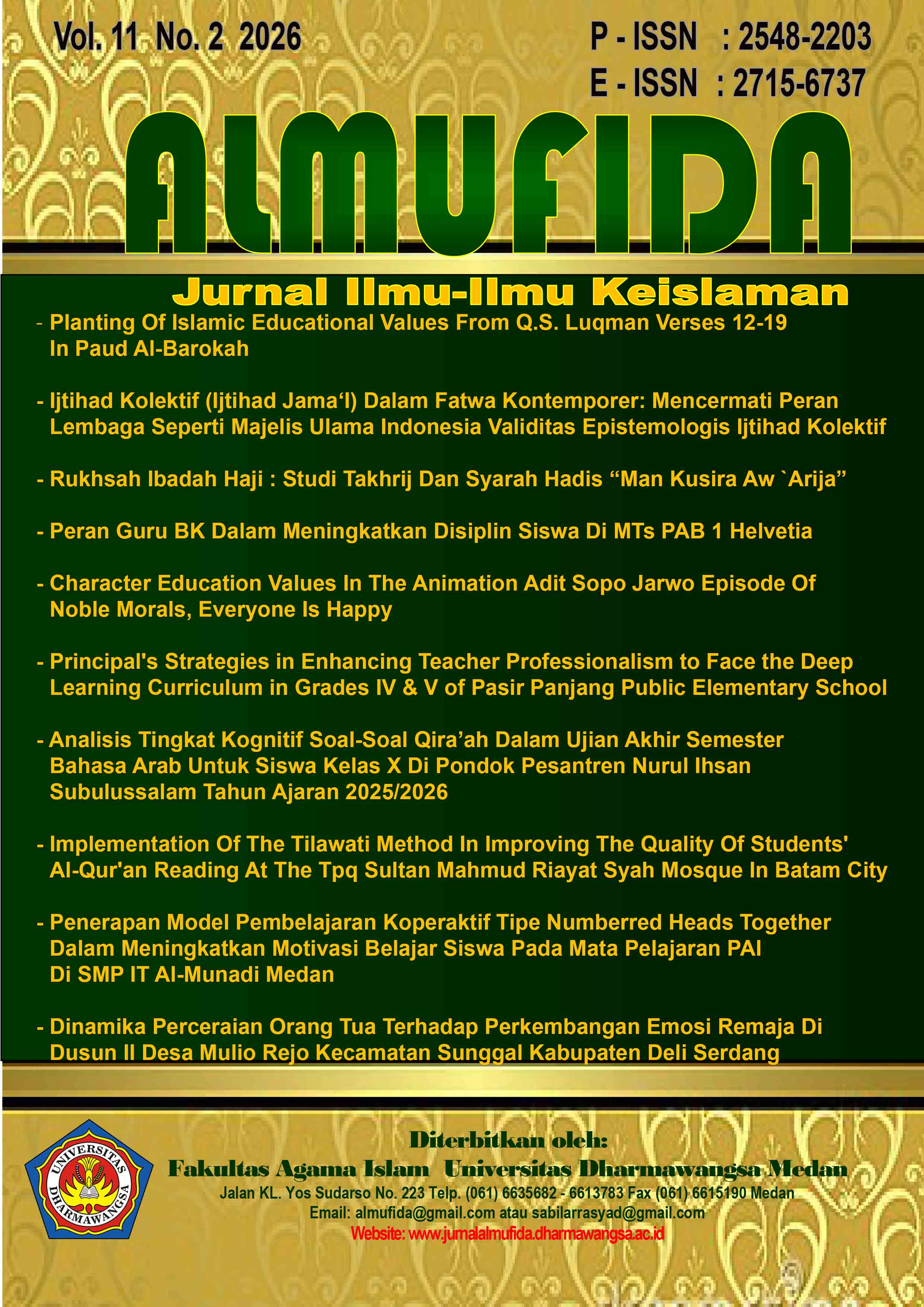
PLANTING OF ISLAMIC EDUCATIONAL VALUES FROM Q.S. LUQMAN VERSES 12-19 IN PAUD AL-BAROKAH
DOI:
https://doi.org/10.46576/almufida.v11i2.9679Keywords:
Role of Teacher PAUD, Values of Islamic Riligiuos Education QS Luqman ayat 12-19.Abstract
Islamic education is a process of directing by providing guidance in an effort to foster and influence based on the Qur'an and As-Sunnah. Surah Luqman verses 12-19 discusses the story of Luqman al Hakim when educating his children about monotheism, worship and morals. QS Luqman verses 12-19 contains Islamic educational values that must be instilled in children to become a guide for life. The objectives of this study are: 1). Describe the values of Islamic education in QS Luqman verses 12-19, 2). Describe the role of PAUD teachers in instilling Islamic educational values based on QS Luqman verses 12-19 in students at PAUD Al-Barokah. This type of research is qualitative field research. This study uses a case study research design. Data collection techniques use interview, observation, and documentation techniques. Furthermore, data analysis was carried out using the case study analysis method, the results of the research that the author has conducted, show that the Islamic educational values of students at PAUD Al-Barokah based on QS Luqman verses 12-19 include the value of monotheism, the value of worship, and moral values consisting of gratitude, patience, devotion to both parents, and avoiding arrogance. The role of PAUD teachers in instilling Islamic educational values based on QS Luqman verses 12-19 in students at PAUD Al-Barokah is to use the habituation method where the habituation method is applied to activities at school such as learning monotheism, congregational dhuha prayer, reading short letters before learning, being polite, greeting teachers and friends when meeting, being kind to parents, speaking politely, carrying out parental orders, carrying out Hajj rituals, practicing ablution
References
Nur Hasanah, Dewi Siti Aisyah (2026), Pencegahan Fatherless Perspektif QS. Luqman ayat 13-19 dalam Pembentukan Moral Anak Usia Dini, Jurnal Qolamuna, Vol.2 No. 2, e- ISSN: 3063-8925, h. 246-247
Nukman Hasibuan, Nuruzzahri, Muhammad Syahrial Razali Ibrahim (2026), Representasi Peran Ayah Dalam Pendidikan Anak (Analisis Tafsir Tarbawi dalam Perspektif Buya Hamka), Jurnal Al-Ikhtibar, Vol. 13 N0.01, h. 33
Selvy Yuspitasari (2026), Relevansi Tafsir Ayat-ayat Tarbawi Terhadap Pendidikan Islam Kontemporer, Jurnal Al-Ibtidaiyah, e-ISSN: 2715-29663, P-ISSN : 271509655, h. 54.
Aslan (2025), Analisis Dampak Kurikulum Cinta dalam Pendidikan Islam Sebagai Pendidikan Transformatif yang Mengubah Perspektif dan Sikap Peserta Didik: Kajian Pustaka Teoritis dan Praktis, Prosiding Seminar Nasional, Vol. 3 No. 1 e-ISSN: 3026-5169.
Evi Nur Khififah, Siti Mufarochah (2022), Penanaman Nilai-nilai Karakter Anak Usia Dini Melalui Pembiasaan Dana Keteladanan, Jurnal At-Thufuly: Pendidikan Anak Usia, Vol. 2. No. 2.
Fatimah Zahrok, Ahmad Nashiruddin (2023), Umar Farouq, Nilai-nilai Pendidikan Anak Usia Dini dalam Al-Qur’an (Studi Surah Luqman ayat 12-19) menurut Tafsir Ibnu Katsir, Jurnal Tinta Emas, Pendidikan Islam Anak Usia Dini, Vol 2. No. 2 e-ISSN: 2830-005X, P-ISSN: 2962-3065.
Raden Ahmad Muhajir Ansori (2016), Strategi Penanaman Nilai-nilai Pendidikan Islam pada Peserta Didik, Jurnal Pusaka ISSN: 2339-2215 h. 16-17.
Agus Nur Qowim (2020), Metode Pendidikan Islam Perspektif Al-Qur’an, Jurnal Ilmu Pendidikan Islam, Volume 3 No. 01 2020, ISSN: 2338-4131
Yuliani Nurani Sujiono (2009), Konsep Dasar Pendidikan Anak Usia Dini , Jakarta: PT INDEKS,
Carol Seefeldt & Barbara A.Wasik (2008), Pendidikan Anak Usia Dini Menyiapkan anak Usia tiga, Empat dan Lima Tahun Masuk Sekolah, Jakarta: pt indeks,
Anita Yus (2011), Model Pendidikan Anak Usia Dini, Jakarta: Kencana,
Moeslichatoen R (2004), Metode Pengajaran di Taman Kanak-kanak, Jakarta: PT Rineka Cipta. Mansur (2022). Pendidikan Anak Usia Dini Dalam Islam, Jakarta: Pustaka Pelajar.
M. Ramli (2005), Pendampingan Perkembangan Naka Usia Dini, Jakarta: Departemen Pendidikan Nasional Direktorat Jendral Pendidikan Tinggi.
Slamet Suyanto (2005), Konsep Dasar Pendidikan Anak Usia Dini, (Jakarta: Departemen Pendidikan Nasional Direktorat Jendral Pendidikan Tinggi Direktorat Pembinaan Pendidikan Tenaga Kependidikan dan Ketenagaan Perguruan Tinggi.
Downloads
Published
Issue
Section
License
Authors who publish with this journal agree to the following terms:- Authors retain copyright and grant the journal right of first publication with the work simultaneously licensed under a Creative Commons Attribution License 4.0 that allows others to share the work with an acknowledgement of the work's authorship and initial publication in this journal.
- Authors are able to enter into separate, additional contractual arrangements for the non-exclusive distribution of the journal's published version of the work (e.g., post it to an institutional repository or publish it in a book), with an acknowledgement of its initial publication in this journal.
- Authors are permitted and encouraged to post their work online (e.g., in institutional repositories or on their website) prior to and during the submission process, as it can lead to productive exchanges, as well as earlier and greater citation of published work (See The Effect of Open Access).
112.jpg)