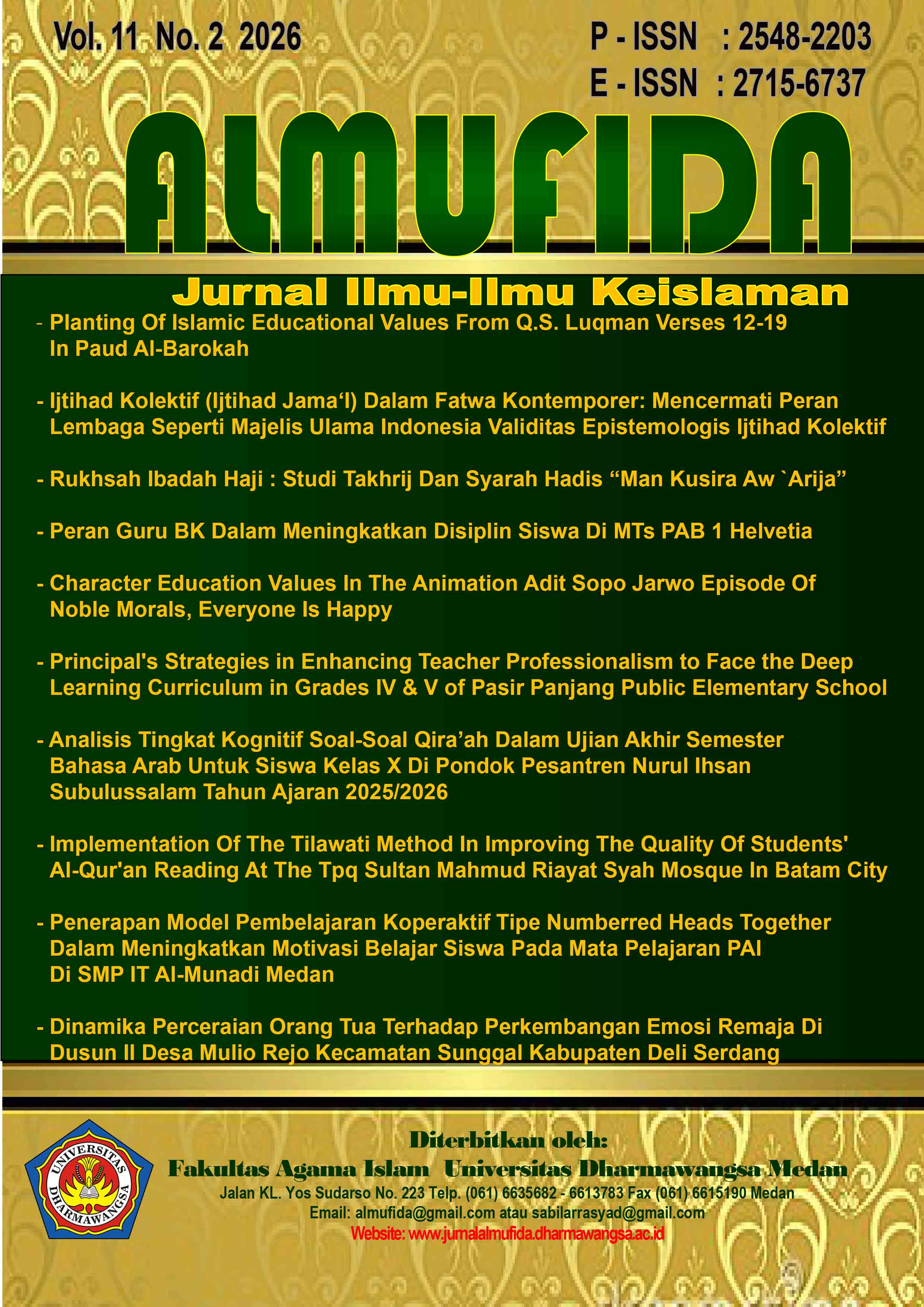
Rukhsah ibadah haji : studi takhrij dan syarah hadis man kusira aw 'arija
DOI:
https://doi.org/10.46576/almufida.v11i2.8684Keywords:
Haji, Rukhsah, Takhrij, Syarah.Abstract
Hajj is one of the five fundamental pillars of Islam and is mandatory for every able Muslim. Islam, a faith that embraces the principle of ease (yusru) and dismisses hardship, has instituted the notion of legal dispensation (rukhsah) in all aspects of worship, including hajj. A key normative basis for rukhṣah in hajj is the hadith man kusira aw arija, allowing pilgrims with physical injuries notably bone fractures or lameness to undertake tahallul prior to finishing the entire set of hajj rites. This research intends to analyze the hadith using two main methodological approaches in hadith studies: takhrij and syarah. The study utilizes a qualitative method rooted in library research, referencing traditional hadith texts and legal literature. The takhrij examination followed the hadith through twelve main references, such as Sunan Abi Daud, Sunan al-Tirmidzi, Sunan al-Nasai, Musnad Ahmad, Ibn Abi Shaybah's al-Mushannaf, and al-Hakim al-Mustadrak, all connecting via Hajjaj ibn ʿAmr al-Ansari unified transmission. A review of the narrators according to al-jarh wa al-taʿdil criteria verified that all transmitters are classified as tsiqah, thus validating the hadith as sahih. The syarah analysis additionally shows that the hadith offers a legal foundation for tahallul for pilgrims encountering physical barriers, reinforcing the wider jurisprudential stance that ihsar includes all types of debilitating hindrances, not just obstruction by enemies. This research adds to the practical hadith sciences and provides a validated normative basis for the application of rukhṣah in modern hajj managementReferences
Aḥmad ibn Ḥanbal. (2001). Musnad Aḥmad ibn Ḥanbal. Beirut: Mu’assasat al-Risalah. Al-Baghawi, al-Ḥusayn ibn Mas‘ud. (1983). Mu‘jam al-ṣaḥabah. Riyadh: Dar al-Rayah. Al-Darimi, ‘Abd Allah ibn ‘Abd al-Raḥman. (2000). Sunan al-Darimi (Ḥusain Salim
Asad) Riyadh: Dar al-Mughni.
Al-Daraquṭni, ‘Ali ibn ‘Umar. (2004). Sunan al-Daraquṭni. Beirut: Mu’assasat al-Risalah. Al-Fawzan, ‘Abd Allah ibn Ṣaliḥ. (2007). Minḥat al-‘allam fi sharḥ bulugh al-maram.
Riyadh: Dar Ibn al-Jawzai
Al-Ḥakim al-Naysaburi, Muhammad ibn ‘Abd Allah. (1990). Al-mustadrak ‘ala al-ṣaḥiḥayn. Beirut: Dar al-Kutub al-‘Ilmiyyah.
Al-Kasani, Abu Bakr ibn Mas‘ud. (1986). Bada’i‘ al-ṣana’i‘ fi tartib al-shari’i‘ (Vol. 2).
Beirut: Dar al-Kutub al-‘Ilmiyyah.
Al-Nawawi, Yaḥya ibn Sharaf. (2000). Al-majmu‘ sharḥ al-muhadhdhab. Beirut: Dar al-Fikr.
Al-Ṭaḥawi, Aḥmad ibn Muḥammad. (1994). Sharḥ mushkil al-athar. Beirut: Mu’assasat al-Risalah.
Al-Ṭaḥḥan, Maḥmud. (1996). Uṣul al-takhrij wa dirasat al-asanid. Riyadh: Maktabah al-Ma‘arif.
Al-Tirmidhi, Muḥammad ibn ‘Isa. (1998). Sunan al-Tirmidhi. Beirut: Dar Iḥya’ al-Turath al-‘Arabi.
Al-Sijistani, Abu Dawud Sulayman ibn al-Ash‘ath. (2009). Sunan Abī Dawad. Beirut: Dar al-Risalah al-‘Alamiyyah.
Al-Zuhayli, Wahbah. (1986). Uṣul al-fiqh al-islami (Vol. 1). Damascus: Dar al-Fikr. Ali Mustafa Yaqub, Kritik Hadis (Jakarta: Pustaka Firdaus, 2015), hlm. 55–57 Anshori, M. (2017). Syarḥ Hadis dari Masa Ke Masa. Jurnal Al-Irfani: Jurnal Kajian
Tafsir Hadits, 3(1), 1–32
Anwar, Syamsul. (2014). Metodologi penelitian hadis. Jurnal Studi Ilmu-Ilmu al-Qur'an dan Hadis, 15(1), 1–22.
Dozan, W., & Sugitanata, A. (2021). Hadits dan takhrij al-hadits. El-Hikam, 14(2), 105–235.
Ikromi, Z. (2020). Fiqh al-hadits: Perspektif metodologis dalam memahami hadis Nabi. Al-Bukhari: Jurnal Ilmu Hadis, 3(1), 105–129. https://doi.org/10.32505/al-bukhari.v3i1.1534
Ibn Abi Shaybah, ‘Abd Allah. (2004). Al-Muṣannaf. Riyadh: Maktabah al-Rushd.
Ibn Kathir, Isma‘il ibn ‘Umar. (1999). Tafsir al-Qur’an al-‘aẓim. Riyadh: Dar Ṭayyibah. Ibn Qudamah, Muwaffaq al-Din. (1968). Al-mughni (Vol. 3). Cairo: Maktabah al-
Qahirah.
Ibn Sa‘d, Muḥammad. (2001). Al-ṭabaqat al-kubra. Beirut: Dar Ṣadir.
Qomarullah, M. (2016). Metode takhrij hadis dalam menakar hadis Nabi. El-Ghiroh, 11(2), 1–23.
Sugitanata, A., & Marhumah, E. (2022). Metode takhrij hadis pada ilmu hadis: Melacak kualitas hadis keutamaan menikah. Tadris : Jurnal Penelitian dan Pemikiran Pendidikan Islam, 17(1), 1 – 22 ..
Mahesti, S. L., & Anasom. (2025). Konsep rukhshah dalam penyempurnaan pelaksanaan ritual ibadah haji bagi jamaah lansia. Al-Qalam: Jurnal Ilmiah Keagamaan dan Kemasyarakatan, 19(2), 919–942. https://doi.org/10.35931/aq.v19i2.4832
Muhtador, M. (2016). Sejarah Perkembangan Metode dan Pendekatan Syarah Hadis,
Riwayah, 2(2), 259–272
Muzakky, A. H., & Mundzir, M. (2022). Ragam metode takhrij hadis: dari Era Tradisional Hingga Digital. Jurnal Studi Hadis Nusantara, 4(1), 74 – 87.
Safri, E. (2014). Metode takhrij hadis. Pekanbaru: Hayfa Press.
Sagala, Azan. 2021. Takhrij Hadis Dan Metode-Metodenya. Al-Ulum: Jurnal Pendidikan Islam 2(2):225–38.
Winarto, Y. (2022). Takhrij hadits Nabi Muhammad dalam Mu‘jam Mufahras li Alfaẓ al-Ḥadith al-Nabawi. Al-Qalam: Jurnal Ilmiah Keagamaan dan Kemasyarakatan, 16(6), 2242–2258. https://doi.org/10.35931/aq.v16i6.1429
Downloads
Published
Issue
Section
License
Authors who publish with this journal agree to the following terms:- Authors retain copyright and grant the journal right of first publication with the work simultaneously licensed under a Creative Commons Attribution License 4.0 that allows others to share the work with an acknowledgement of the work's authorship and initial publication in this journal.
- Authors are able to enter into separate, additional contractual arrangements for the non-exclusive distribution of the journal's published version of the work (e.g., post it to an institutional repository or publish it in a book), with an acknowledgement of its initial publication in this journal.
- Authors are permitted and encouraged to post their work online (e.g., in institutional repositories or on their website) prior to and during the submission process, as it can lead to productive exchanges, as well as earlier and greater citation of published work (See The Effect of Open Access).
112.jpg)