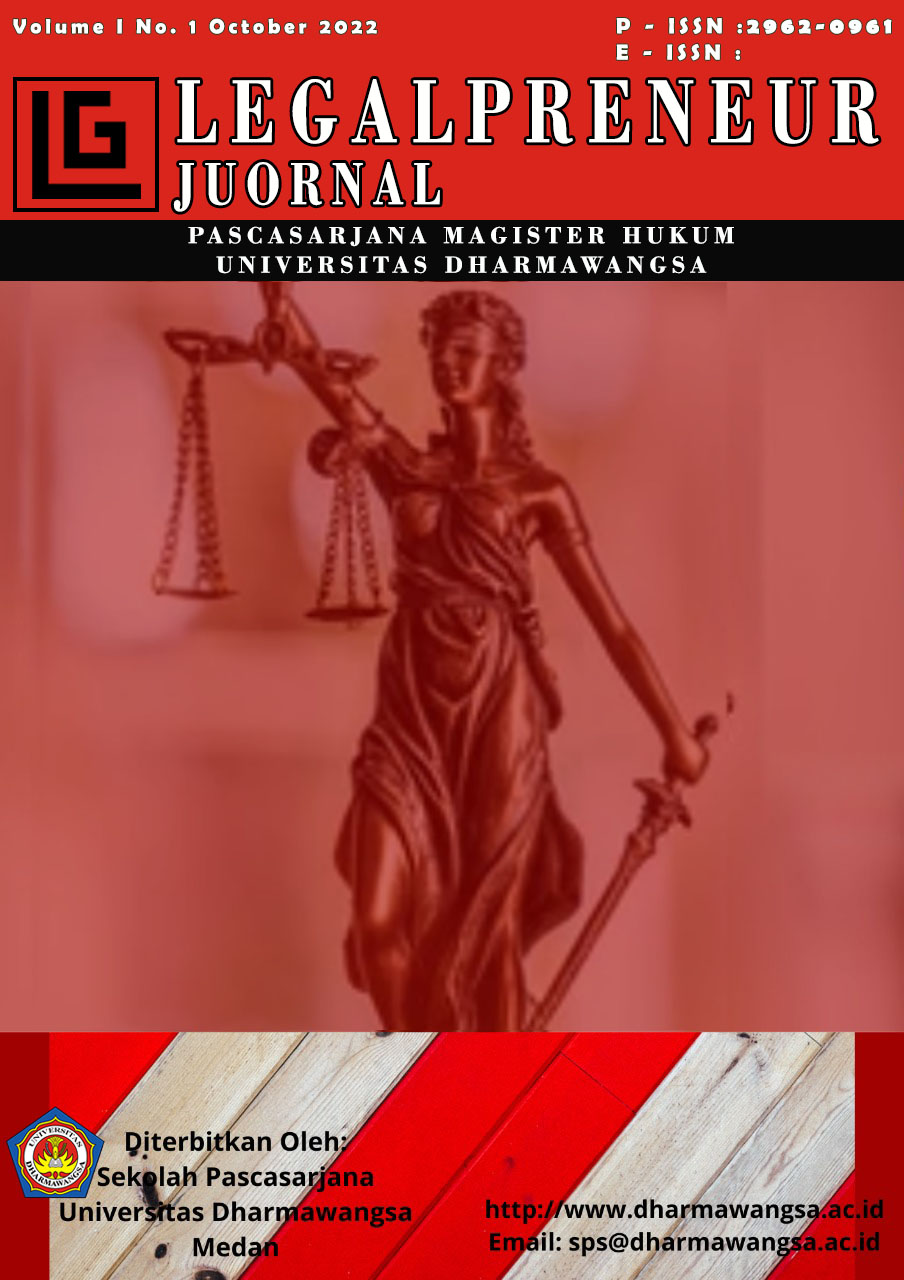
Efforts To Resolve Child Victims Of Violence In The Household
DOI:
https://doi.org/10.46576/lpj.v1i1.4737Keywords:
Legal Protection, Child, Psychological CrimeAbstract
Psychological violence against children within the family is the biggest problem that needs to be considered. Therefore, legal protection is needed for children who receive psychological violence in the family. The problem raised in this thesis is how to enforce the law against children who are victims of psychological violence in the domestic sphere. How is the effort to resolve the law against children who are victims of psychological violence in the domestic sphere. How is the legal protection of child victims of psychological pindana acts within the scope of the household. The research method used in this study is normative juridical research. Normative legal research is secondary data. The nature of this study is descriptive analysis. Data collection techniques this study was conducted by the method of library research (library research). Law enforcement against children who are victims of psychological violence in the household is the application of the law,namely Article 45 paragraph (1) of Law No. 23 of 2004 states that everyone who commits acts of psychological violence in the household as referred to in Article 5 letter b shall be punished with imprisonment for a maximum of 3 (three) years or a maximum fine of Rp 9,000,000.00 (nine million rupiah). Efforts to resolve the law against children who become victims of psychological crime within the scope of the household is done in two ways, namely non-penal settlement and penal settlement. The stages carried out outside the court are (1) agreeing to go through a mediation process. 2) Understand the problems. (3) Generate problem – solving options. (4) Reach an agreement. (5). Execute the deal.References
Abu Huraerah, M.Si, 2012, Kekerasan Terhadap Anak, Bandung, Penerbit Nuansa Cendek
Asri Wijayanti, Hukum Ketenagakerjaan Pasca Reformasi, Jakarta: Sinar Grafika, 2009
Haris Pratama Teguh, S.H.I, M.H., Teori dan Praktek Perlindungan Anak dalam Hukum Pidana, Yogyakarta: Andi Offset, 201
Harun M.Husen, Kejahatan dan Penegakan Hukum Di Indonesia, Jakarta: Rineka Cipta, 1990
Moeljatno, Asas-asas Hukum Pidana, Surabaya: Putra Harsa 1993
Shanty Dellyana, SH, , Wanita Dan Anak Di Mata Hukum, Yogyakarta: Penerbit Liberty, 1988
Sholeh Soeaidy, S.H dan Drs Zulkhair, Dasar Hukum Perlindungan Anak, Jakarta: CV. Noviando Pustaka Mandiri, 200 1.
Soerjono Soekanto, Faktor-faktor Yang Mempengaruhi Penegakan Hukum, Jakarta: UI Pres, 1983.
Syamsul Arifin, Pengantar Hukum Indonesia, Medan: Medan area University Press, 2012
Tim penyusun Kamus Pusat Pembinaan dan pengembangan Bahasa, Kamus Besar Bahasa Indonesia, Edisi kedua, cet. 1,Jakarta: Balai Pustaka, 1991
Downloads
Published
Issue
Section
License
By submitting the article/manuscript of the article, the author(s) agree with this policy. No specific document sign-off is required.
1. License
The article will be governed by the Creative Commons Attribution license as currently displayed on Creative Commons Attribution 4.0 International License
2. Author(s)' Warranties
The author warrants that the article is original, written by stated author(s), has not been published before, contains no unlawful statements, does not infringe the rights of others, is subject to copyright that is vested exclusively in the author and free of any third party rights, and that any necessary written permissions to quote from other sources have been obtained by the author(s).
3. User Rights
The spirit of Legal Preneur (JLPR) is to disseminate articles published are as free as possible. Under the Creative Commons license, JLPR permits users to copy, distribute, display, and perform the work. Users will also need to attribute authors and JLPR on distributing works in the journal and other media of publications.
4. Rights of Authors
Authors retain all their rights to the published works, such as (but not limited to) the following rights;
- Copyright and other proprietary rights relating to the article, such as patent rights,
- The right to use the substance of the article in own future works, including lectures and books,
- The right to reproduce the article for own purposes,
- The right to self-archive the article,
- The right to enter into separate, additional contractual arrangements for the non-exclusive distribution of the article's published version (e.g., post it to an institutional repository or publish it in a book), with an acknowledgment of its initial publication in this journal.
5. Co-Authorship
If the article was jointly prepared by more than one author, any authors submitting the manuscript warrants that he/she has been authorized by all co-authors to be agreed on this copyright and license notice (agreement) on their behalf, and agrees to inform his/her co-authors of the terms of this policy. JLPR will not be held liable for anything that may arise due to the author(s) internal dispute. JLPR will only communicate with the corresponding author.
6. Royalties
Being an open accessed journal and disseminating articles for free under the Creative Commons license term mentioned, author(s) aware that JLPR entitles the author(s) to no royalties or other fees.
7. Miscellaneous
JLPR will publish the article (or have it published) in the journal if the article’s editorial process is successfully completed. JLJ's editors may modify the article to a style of punctuation, spelling, capitalization, referencing and usage that deems appropriate. The author acknowledges that the article may be published so that it will be publicly accessible and such access will be free of charge for the readers as mentioned in point 3.