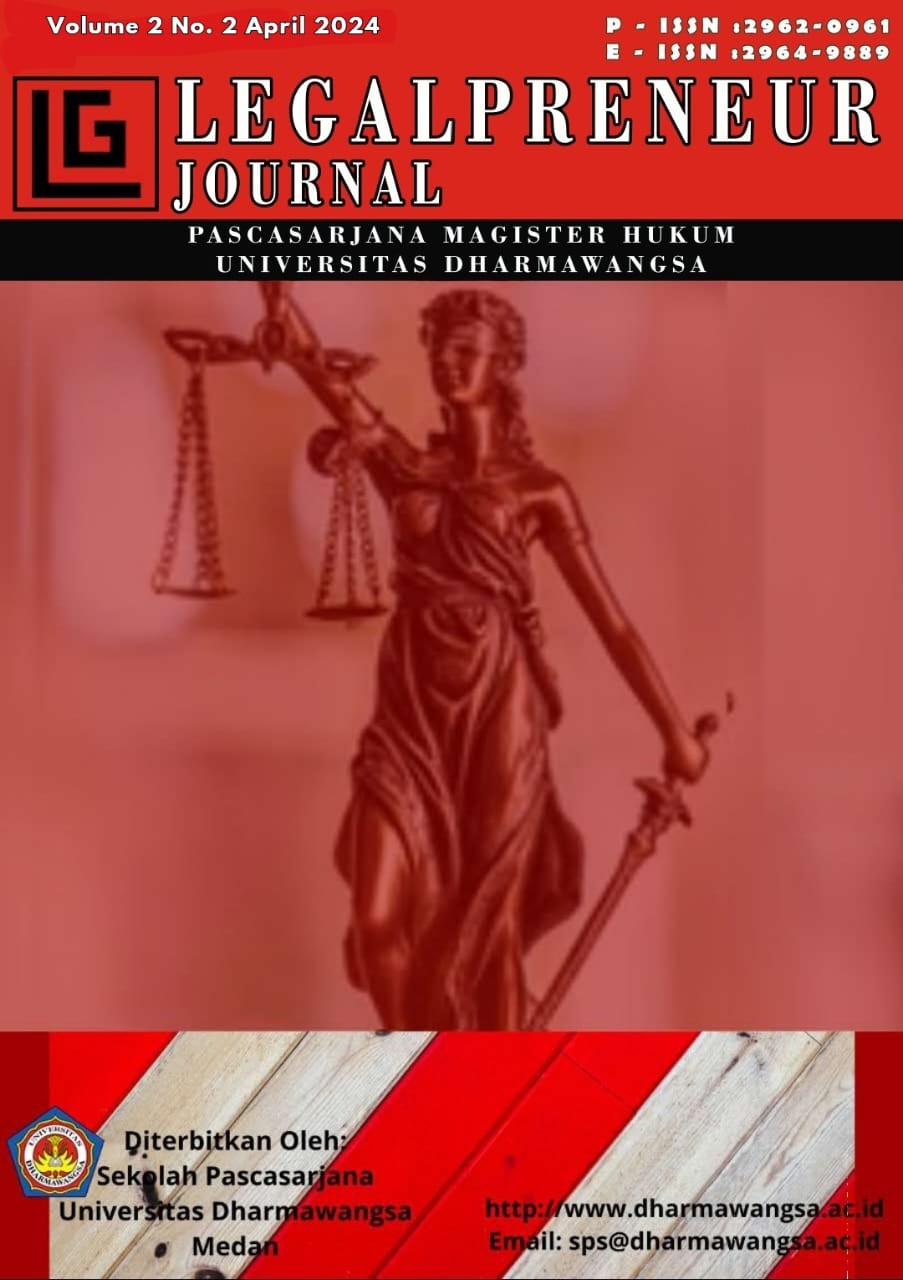
Legal Principles Against Gambling Establishments
DOI:
https://doi.org/10.46576/lpj.v2i2.4290Kata Kunci:
Impact, law, localization of gamblingAbstrak
Gambling establishments are the root of the problem of gambling and become a source of other violations of the law.by the rules of criminal law with law No. 7 of 1974 on the control of gambling, gambling is a very clear action in the rule of Law Article 303 of the Criminal Code as a complement by its implementing regulations such as Government Regulation No. 9 of 1981 on the implementation of Law No. 7 of 1974 on the regulation of gambling. so that all actions related to gambling are strictly prohibited in Indonesian law, whether carried out by legal entities or government and private.Decisive action is the right step in the handling of gambling facilities and infrastructure. This research method using normative juridical methods.
Referensi
Afzalur Rahman, Economic Doctrines of Islam, Vol 3, Islamic Publications, Lahore, 1974,
Ahamad Kursairi Suhail, Bahaya Judi, Dalam Kolom Hikmah, Republika tanggal 30 Januari 2004
Ariman Sitompul . Alternative Dispute Resolution Criminal Acts Of Money Politics In Elections In View Of Normative Law. International Asia Of Law and Money Laundering (IAML), 2(1), 1–9. 2023 https://doi.org/10.59712/iaml.v2i1.52
Ariman Sitompul, P Hasibuan, M Sahnan. The Morality Of Law Enforcement Agencies (Police, Prosecutor's Office, KPK) In Money Laundering With The Origin Of The Corruption. European Science Review 9 (10),2021.
Ariman Sitompul, Sabela Gayo. The Use of Mediation as an Alternative Health Dispute Resolution. Hong Kong Journal of Social,2022.
Ariman Sitompul,Mhd.Nasir Sitompul, The Combination Of Money Laundering Crime With The Origin Of Narkotics Crime To Islamic Law. In Proceeding International Seminar of Islamic Studies (Vol. 1, No. 1),2020.https://jurnal.umsu.ac.id/index.php/insis/article/view/4233
Ayub, Muhammad (2007). Understanding Islamic Finance. Wiley. Retrieved 24 January 2015.
Direktur Tehnik Asuransi Tugu Pratama, General Insurance terbesar di Indonesia, Anggota Dewan Penasehat Asosiasi Asuransi Syariah Indonesia (AASI)."Islamic Finance. Q&A. What is the Difference Between Qimar and Maisir?". investment-and-finance. Nov 23, 2013. Retrieved 24 January 2015.
Husain Hamid Hisan, Dr. Hukmu Asy-Syari`ah Al-Islamiyah Fii Uquudi Atta`min. darul I`tisham. Kairo
Jamaldeen, Faleel (2012). Islamic Finance For Dummies. John Wiley & Sons. p. 17. ISBN 9781118233900. Retrieved 15 March 2017.
Mohd Fadzli Yusof. Takaful Sistem Insurans Islam. Tinggi Press. SDN BHD
Muhaimin Iqbal, Asuransi Setelah Fatwa Bunga Bank Riba Oleh MUI (makalah diskusi Intern AASI, 2003)
Mustafa Ahmad Zarqa, prof dalam A. Latif Mukhtar
Rafiq al-Mishri, Al-Maisir Wal Qimar Syafi`i Antonio, Bisnis Cara Rosul, Republika.
Sudargo Gautama, Aneka Hukum Arbitrase, Bandung: PT Citra Aditya Bakti,
Unduhan
Diterbitkan
Terbitan
Bagian
Lisensi
By submitting the article/manuscript of the article, the author(s) agree with this policy. No specific document sign-off is required.
1. License
The article will be governed by the Creative Commons Attribution license as currently displayed on Creative Commons Attribution 4.0 International License
2. Author(s)' Warranties
The author warrants that the article is original, written by stated author(s), has not been published before, contains no unlawful statements, does not infringe the rights of others, is subject to copyright that is vested exclusively in the author and free of any third party rights, and that any necessary written permissions to quote from other sources have been obtained by the author(s).
3. User Rights
The spirit of Legal Preneur (JLPR) is to disseminate articles published are as free as possible. Under the Creative Commons license, JLPR permits users to copy, distribute, display, and perform the work. Users will also need to attribute authors and JLPR on distributing works in the journal and other media of publications.
4. Rights of Authors
Authors retain all their rights to the published works, such as (but not limited to) the following rights;
- Copyright and other proprietary rights relating to the article, such as patent rights,
- The right to use the substance of the article in own future works, including lectures and books,
- The right to reproduce the article for own purposes,
- The right to self-archive the article,
- The right to enter into separate, additional contractual arrangements for the non-exclusive distribution of the article's published version (e.g., post it to an institutional repository or publish it in a book), with an acknowledgment of its initial publication in this journal.
5. Co-Authorship
If the article was jointly prepared by more than one author, any authors submitting the manuscript warrants that he/she has been authorized by all co-authors to be agreed on this copyright and license notice (agreement) on their behalf, and agrees to inform his/her co-authors of the terms of this policy. JLPR will not be held liable for anything that may arise due to the author(s) internal dispute. JLPR will only communicate with the corresponding author.
6. Royalties
Being an open accessed journal and disseminating articles for free under the Creative Commons license term mentioned, author(s) aware that JLPR entitles the author(s) to no royalties or other fees.
7. Miscellaneous
JLPR will publish the article (or have it published) in the journal if the article’s editorial process is successfully completed. JLJ's editors may modify the article to a style of punctuation, spelling, capitalization, referencing and usage that deems appropriate. The author acknowledges that the article may be published so that it will be publicly accessible and such access will be free of charge for the readers as mentioned in point 3.