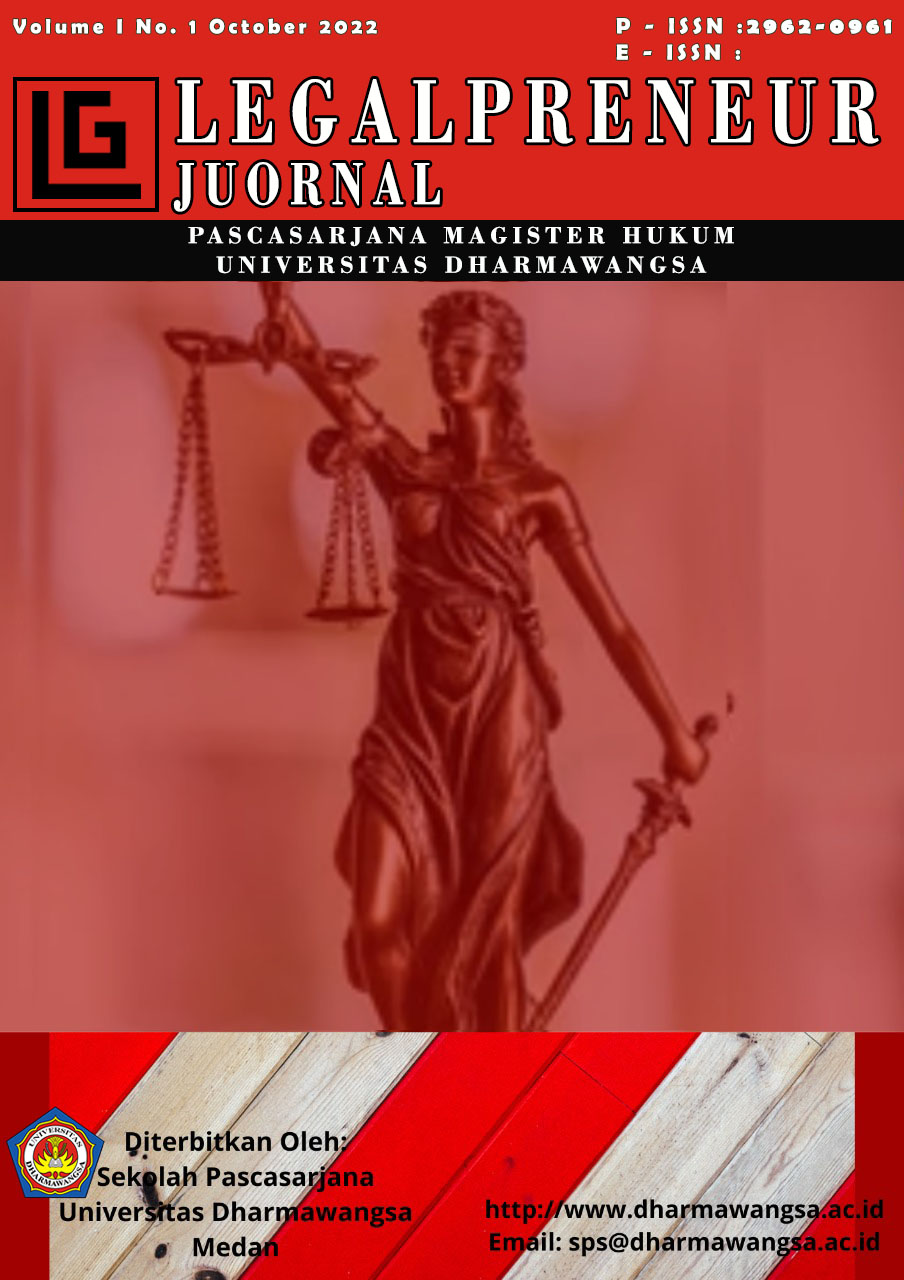
Legal Protection For Outsourced Workers Who Are Dismissed Due To Disability Due To Work Accidents
DOI:
https://doi.org/10.46576/lpj.v1i1.2638Abstrak
Workers / laborers can get work accident insurance if the employer or company has registered themselves and their workers as participants in the BPJS Ketenagakerjaan program. Based on the results of the study, the conclusion in this study is that the legal relationship between companies and workers based on Labor Law is the relationship between employers and workers/workers based on labor agreements, which have elements of work, wages, and orders and are regulated in Law Number 11 of 2020 concerning job creation. Based on Law Number 11 of 2020 concerning job creation Article 116, Article 117, Article 123 Article 124 and Article 151. One of the obligations of employers is to provide protection and safety for outsourced labor, especially for workers who have had work accidents who perform one job related to employment relations, in accordance with Article 151 Number 1 of the job creation Law Number 11 of 2020 stating employers or workers, unions/trade unions, and the government, with all efforts must try to avoid layoffs. Work accident that occurred in Sujatmiko resulting in defects in the hand, but as a result of the incident Sujatmiko laid off from his workplace, namely PT. PT. BIA without severance pay. Dinasker party gave a summons to PT. BIA. Then there was a bipartite meeting between Sujatmiko and PT. BIA accompanied by PT. KMP running Time 2 weeks finally PT. BIA issued severance pay of Rp.60,000,000 to Sujatmiko provided that the money given to PT. KMP to be channeled to Sujatmiko.
Unduhan
Diterbitkan
Terbitan
Bagian
Lisensi
By submitting the article/manuscript of the article, the author(s) agree with this policy. No specific document sign-off is required.
1. License
The article will be governed by the Creative Commons Attribution license as currently displayed on Creative Commons Attribution 4.0 International License
2. Author(s)' Warranties
The author warrants that the article is original, written by stated author(s), has not been published before, contains no unlawful statements, does not infringe the rights of others, is subject to copyright that is vested exclusively in the author and free of any third party rights, and that any necessary written permissions to quote from other sources have been obtained by the author(s).
3. User Rights
The spirit of Legal Preneur (JLPR) is to disseminate articles published are as free as possible. Under the Creative Commons license, JLPR permits users to copy, distribute, display, and perform the work. Users will also need to attribute authors and JLPR on distributing works in the journal and other media of publications.
4. Rights of Authors
Authors retain all their rights to the published works, such as (but not limited to) the following rights;
- Copyright and other proprietary rights relating to the article, such as patent rights,
- The right to use the substance of the article in own future works, including lectures and books,
- The right to reproduce the article for own purposes,
- The right to self-archive the article,
- The right to enter into separate, additional contractual arrangements for the non-exclusive distribution of the article's published version (e.g., post it to an institutional repository or publish it in a book), with an acknowledgment of its initial publication in this journal.
5. Co-Authorship
If the article was jointly prepared by more than one author, any authors submitting the manuscript warrants that he/she has been authorized by all co-authors to be agreed on this copyright and license notice (agreement) on their behalf, and agrees to inform his/her co-authors of the terms of this policy. JLPR will not be held liable for anything that may arise due to the author(s) internal dispute. JLPR will only communicate with the corresponding author.
6. Royalties
Being an open accessed journal and disseminating articles for free under the Creative Commons license term mentioned, author(s) aware that JLPR entitles the author(s) to no royalties or other fees.
7. Miscellaneous
JLPR will publish the article (or have it published) in the journal if the article’s editorial process is successfully completed. JLJ's editors may modify the article to a style of punctuation, spelling, capitalization, referencing and usage that deems appropriate. The author acknowledges that the article may be published so that it will be publicly accessible and such access will be free of charge for the readers as mentioned in point 3.